

The year 2025 will have been a particularly difficult and eventful period for France. Beyond the economic figures, the political landscape was marked by significant instability that weighed on the business climate, corporate confidence, and the strategic decisions of CFOs and part-time CFOs. Amid institutional uncertainty, moderate growth, pressure on corporate cash flow, and adjustments to financial practices, this year stands out as a pivotal period for French economic stakeholders.
Table of Contents
1. Political instability:
—a year marked by governmental and social crises
One of the defining events of 2025 in France was the political instability that cast a shadow over the institutional landscape. This instability was not merely background noise: it directly affected business confidence, budget forecasts, and investment decisions.
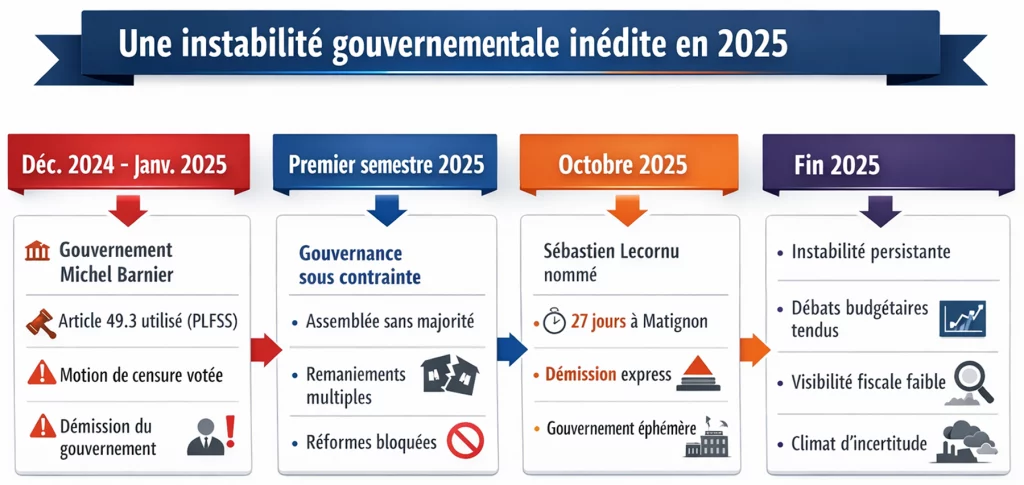
This institutional instability has fueled a climate of political uncertainty, which has been reflected in both the fiscal outlook and business confidence. The National Assembly remained deeply fragmented, making it difficult to reach any budget compromise or implement structural reforms. Many economic observers have pointed out that this political instability became one of the main obstacles to economic growth in 2025.
A social and fiscal issue centered on the Zucman tax
Beyond the government crises, the year 2025 was also marked by a highly polarized public debate on tax issues, particularly regarding the so-called “Zucman tax” proposal. This measure, championed by a faction of the parliamentary left, sought to establish a 2% minimum tax on the wealth of households with more than 100 million euros, with the stated goal of strengthening tax justice and contributing to the recovery of public finances.
The debate intensified throughout the year, particularly during the review of the 2026 budget bills. Adopted on first reading in the National Assembly but later rejected by the Senate, the proposal became a major political flashpoint, with some parliamentary groups making their support for the government contingent on the adoption of this measure. This sequence of events fueled a climate of social and ideological confrontation, revealing deep divisions over the distribution of the tax burden and the role of the wealthy in financing the national economy.
For economic stakeholders—and in particular for business leaders and financial executives—this debate has contributed to a heightened sense of regulatory uncertainty. Discussions surrounding the Zucman tax have reignited fears regarding the stability of France’s tax framework, the country’s attractiveness to investors, and the predictability of the economic playing field. While it did not spark massive social mobilization comparable to traditional labor union movements, this controversy nevertheless had a lasting impact on the business climate in 2025, fueling a perception of heightened political and fiscal risk in investment and wealth structuring decisions.
2. Economic Growth:
Prevention, Slowdown, and Cautious Forecasts
Moderate growth in 2025
From a macroeconomic perspective, France experienced moderate growth in 2025, well below its historical performance. According to projections by the OECD and the European Commission, French GDP growth is estimated at around 0.7% in 2025, compared with approximately 1.2% in 2024, marking a significant slowdown.
This moderate growth can be attributed to several factors:
- weak domestic demand, hampered by rising political uncertainty and cautious consumer spending;
- an investment climate dampened by fiscal risks and institutional volatility;
- some caution regarding productive investments, even though certain sectors (notably technology and defense) have shown signs of momentum.
Short-Term Forecasts
Macroeconomic projections suggest that the French economy is expected to rebound slightly over the next few years, though the overall situation remains fragile. According to the Banque de France’s forecasts, growth is expected to reach about 1% in 2026, driven by a slight rebound in consumer spending and stronger business investment.
The IMF (International Monetary Fund) also anticipates a moderate recovery, with growth of around 1% in 2026, but emphasizes that this recovery will depend on an improvement in consumer and business confidence, as well as a reduction in political uncertainty.
Inflation, Unemployment, and Consumer Spending
Inflation in France remained relatively low in 2025, partly due to a decline in energy prices and measures to stabilize regulated prices. However, this low inflation did not translate into a strong rebound in consumption, which remained subdued by low consumer confidence and increased caution in consumer spending.
The situation in the labor market was mixed: the unemployment rate remained high, hovering around 7.5 percent, with slight upward pressure as economic activity slowed.
3. French Companies:
Structural Challenges, Strained Sectors, and Opportunities
Productive Economy: Business Operations Under Constraints and Increased Competitive Pressure
In 2025, French SMEs operated in an environment characterized by generally sluggish business activity and increased competitive pressure, particularly in sectors exposed to international trade. Economic indicators, notably the PMIs, frequently fluctuated around the stagnation threshold, reflecting fragile growth that was often insufficient to offset rising costs.
For many small and medium-sized industrial and service companies, this situation has resulted in a gradual squeeze on margins. Rising costs for supplies, energy, transportation, and certain imported inputs have not always been fully passed on to sales prices, due to more price-sensitive demand and increased competition, including from foreign players. In this context, executives have often been forced to balance maintaining sales volumes, preserving margins, and securing cash flow.
Sectors that have historically been key to the economy—such as the automotive, metalworking, and electronics industries, as well as certain segments of the construction industry—have been particularly hard hit. Small and medium-sized enterprise (SME) subcontractors have borne the brunt of production rate adjustments by major contractors, facing sudden fluctuations in workload, reduced visibility into order books, and increased dependence on a few key customers.
Transportation and Aviation: Indirect Effects on SMEs
While major airlines showed some resilience in 2025, the impact on small and medium-sized enterprises (SMEs) was more mixed. Companies operating in subcontracting, maintenance, airport services, or logistics benefited from a generally steady level of business, but often at the cost of tighter commercial terms.
For these small and medium-sized enterprises, the challenge was not so much revenue growth as it was the quality of that revenue: longer payment terms, contract renegotiations, price pressure, and increased working capital needs. This situation has underscored the importance of cash flow management, which has become a key factor in ensuring survival and financial stability.
Tourism and Services: A Positive but Uneven Trend
The tourism sector was one of the main drivers of economic activity in 2025, greatly benefiting local small and medium-sized enterprises (SMEs), including independent hotels, restaurants, leisure businesses, visitor services, and regional transportation. The increase in the number of international visitors and the strong performance of domestic tourism generated significant pockets of growth, particularly in tourist areas and major metropolitan areas.
However, this positive momentum has not come without its challenges. Many small and medium-sized tourism businesses have had to contend with rising labor costs, recruitment difficulties, and pressure on commercial and residential real estate. As a result, business growth has been accompanied by increased complexity in operational and financial management, forcing executives to further professionalize their management practices.
Investment, Innovation, and Attractiveness: Caution and Selectivity
In 2025, French SMEs continued to invest selectively and cautiously. Political and fiscal uncertainty led many business leaders to postpone or scale back certain strategic projects, favoring investments with a quick return on investment that focused on productivity, automation, or cost reduction.
Innovation remained a constant, though it was often targeted. The most dynamic SMEs continued to invest in digital technology, artificial intelligence, management tools, and process optimization—not with a view to aggressive expansion, but as a means of building resilience and competitiveness. The French tech ecosystem continued to thrive, but access to financing remained more challenging for SMEs, with investors becoming more selective and profitability criteria tightening.
In this context, France’s appeal to foreign investors has primarily benefited large-scale or innovative projects, while small and medium-sized enterprises (SMEs) have had to rely more on their own resources, their ability to generate cash flow, and their financial strength to continue growing.
4. Business Climate and Outlook for Investors
Business Climate in France
According to the Business Climate Survey France 2025, despite a slight decline in profitability for some companies, overall confidence in the business climate remains relatively strong, with a significant percentage of international companies planning to maintain or increase their investments in France. This trend underscores that the country remains attractive to certain international investors, despite the complex political and economic environment.
Late Payments and Corporate Cash Flow
In 2025, longer payment terms emerged as a major source of vulnerability for small and medium-sized enterprises (SMEs) and mid-sized companies. Delayed customer payments had a direct impact on cash flow, against a backdrop of moderate growth and limited visibility, turning working capital needs into a major source of strain for many companies.
In light of this, the strongest companies have tightened their accounts receivable management practices: faster invoicing, systematic tracking of collections, and prioritizing follow-ups with at-risk customers. Monitoring DSO (average days sales outstanding) and the concentration of revenue among a few major clients have become key decision-making indicators.
To accommodate these structurally longer payment cycles, some SMEs have adopted cash flow management tools (factoring, short-term credit lines, supplier renegotiation) not as emergency solutions, but as management tools. In this context, the CFO has played a central role in securing cash flow, balancing growth against customer risk, and preventing late payments from becoming a lasting obstacle to business operations.
5. Impacts on CFOs and Part-Time CFOs
The year 2025 transformed the way corporate finance is managed in France. Financial executives had to navigate an environment marked by political uncertainty, pressure on cash flow, and sluggish growth.
A Strengthened Strategic Role
For CFOs, 2025 marked an increase in strategic responsibility. Their role is no longer limited to accounting compliance or budget management: they must now factor unstable macroeconomic scenarios, frequently revised budget projections, and risks of political volatility into their day-to-day decisions. More than ever, the finance function is becoming a key driver for anticipating risks and adapting quickly.
Agility and Flexibility: The Role of Part-Time CFOs
The shared-time CFO model has emerged as a suitable solution for many small and medium-sized businesses and mid-sized companies. In an environment where budget constraints and cost pressures require a more flexible, results-oriented management approach, these roles enable:
- to provide cutting-edge strategic expertise without excessively high fixed costs;
- to develop more flexible cash management solutions;
- to optimize the trade-offs between growth, innovation, and financial prudence;
- to quickly adjust forecasts and budgets in response to macroeconomic and policy signals.
This model has been particularly appealing to companies undergoing transformation or facing industry-specific challenges, as it combines financial discipline with operational agility.
Chief Financial Officer and Digital Transformation
In response to market volatility, CFOs have accelerated the digital transformation of finance functions by adopting automation tools, advanced analytics platforms, and real-time management systems that improve visibility into performance and risks. These technology investments are part of a strategy focused on sustainable performance, looking beyond the short term.
Conclusion: "
"—A Year of Transformative Transition
The year 2025 in France will have been a year of fundamental transition: political instability, moderate economic growth, pressure on corporate cash flow, and profound changes in financial practices. Chief financial officers played a central role in helping companies adapt to these challenges by combining rigor, foresight, and innovation.
This assessment shows that France, despite an uncertain global environment, remains a dynamic economy capable of attracting investment, fostering innovation, and maintaining a certain level of confidence in the entrepreneurial sector.
For 2026, the main challenge will be to stabilize the political and economic framework in order to strengthen growth, facilitate productive investment, and provide finance leaders with a more solid basis for decision-making.